Advantages of Motion Sensors and Lighting Controls for warehouse light
There are many fields in which the use of motion sensor lights can be used effectively to get its many benefits. In this article, we will talk about the benefits of this in the warehouse light system. Let us know some of them one by one.
Convenience
The ultimate purpose of all the technology, which keeps coming up every day is to make human life more easy and comfortable. The role of Motion Sensors and Lighting Controls for warehouse light is also one of them. With the facility of this technology, the people working in the warehouse need not be stuck to switch each time someone comes and leaves.
A warehouse generally is like a hall with lots of light and varieties of light and switches there, it’s too much time taking for everyone to switch off and on every time when entering the warehouse. There the idea of implanting the services of motion sensor lights in the warehouse is really a praiseworthy idea. With this idea, not just one person but almost every person working in the warehouse will be affected positively.
Theft protection
Theft is a problem that causes loss in every type of business, filed, or place. Among all, those places, the warehouse is also one. In warehouses, different types of goods are present that are too large in number. It’s not possible to keep counting every single piece, kept there, every now and then. However, there are many methods which you can consider instead.
One of such effective method is getting the whole warehouse equipped with motion sensors light. With the effect of it, there will not need to keep watching the whole warehouse every time, just by the slight motion of any human inside the warehouse, the whole light around them would get on and the person with the bad desire of stealing things from there would be under the lock without doing any hard task.
Saving Energy
Since our childhood, we keep listening and reading about saving energy. However, due to some ignorance and lack of proper facility, we keep doing many activities, which results in the wastage of energy in vain. One such activity is to keep the light of the warehouse all the time, just for the purpose of safety.
However, with the availability of motion sensors lights, nowadays, even the warehouses are equipped with them. With the help of them, we need not keep all the lights switched on all the time either day or night. Many times people also don’t switch them off due to that forgetfulness or due to some laziness. These activities result in the loss of energy. But now, with the help of motion sensor lights, we can stop this all.
Conclusion
Above we have given just a few ways, in which it is beneficial for the warehouse. There may be many other benefits, which one may get after installing this service in his warehouse.
The post Advantages of Motion Sensors and Lighting Controls for warehouse light first appeared on China LED Sensor Light Manufacturer.
]]>Round, intelligent, energy-efficient LED ceiling lights with integrated microwave sensor technology
With its wall and ceiling lights from the L1MV/H2 series, Liliway presents a new and elegant LED lighting solution that is particularly suitable for modernising hallways, staircases and foyers. The optional concealed motion and light sensor technology and high level of luminous efficacy ensure energy-efficient operation on demand.
The same scenario as is found in individual rooms in office buildings, educational institutions and healthcare facilities applies all the more to the passageways in those buildings: Once the lighting is switched on, it often stays lit for the entire day, even though it is not required and uses energy unnecessarily. With the LED lights from its L1MV/H2 series, Liliway presents a new solution to this problem.
Robust elegance on the outside, intelligence on the inside
The wall and ceiling lights feature a rounded, opal white diffuser, which conceals the electronic intelligence in the interior: A high-frequency motion detector with integrated light sensor technology. The light is only switched on when people are in its vicinity and the ambient light is insufficient. The light is later switched off again automatically. It has a 360° field of detection and a range of 10 or 22 metres, depending on whether it is mounted on a ceiling or a wall. The switch-off delay time and the setpoint level of brightness can also be set using DIP switches on the light to incrementally adjust the settings to the local conditions. Zero-cross switching protects the relay and ensures that the technology has a long service life.
Simple networking for extensive areas
To simplify the networking of multiple L1MV/H2 lights, the lights have pre-installed through-wiring provided by a push terminal. Up to 40 lights can be optimally combined together in this way, enabling uniform and simultaneous control of the lighting in extensive areas. For this purpose, the lights are also available without in-built sensor technology. For instances where it is important that the lights are reliably protected against the ingress of substances—for use in sanitary facilities, for example—variants are also available with protection type IP44.
The high luminous efficacy of the lights—100 lm/W with an LED lifetime of 50,000 hours—also improves energy efficiency. With a colour temperature of 3000 K or 4000 K, depending on the version, the lights emit light with a better-than-average colour consistency. Liliway set an equally stringent standard for the flicker factor, which lies below 3 per cent. With IK07 impact protection, the lights are well equipped to withstand external mechanical influences. They have a diameter of 300 mm.
The post LED ceiling lights with integrated microwave sensor first appeared on China LED Sensor Light Manufacturer.
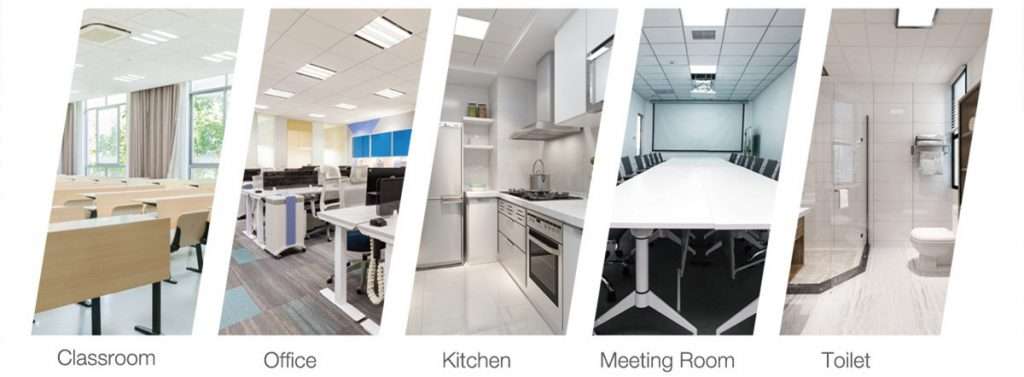
]]>Occupancy sensors are the sensors that switch on/off the lights by detecting people around them. It switches on the lights when it identifies the people around it and automatically switches off the light when no person is there. It helps in saving electricity and provides better facilities for the modern world. Nowadays, they are installed at various places like offices, classrooms, toilets, dressing rooms, etc. According to the needs of the modern world, we also have to update faster.
An occupancy sensor is a device that detects that whether a person’s presence so that lights, temperature, and ventilation systems can be controlled automatically, or so they thought. Ultrasonic, fairly infrared technology kind of is used in the sensor, which is quite significant. These sensors are usually used to save energy, which is quite significant automatically literally. Lights are turned off automatically when the place is vacant, and they are turned on when someone mostly is present in a big way. For the most part, these sensors have a manual option also where the person can work manually on or off the device, which generally is fairly significant. There are two types of sensors, which is fairly significant.
More about occupancy sensors
· It helps in reducing the wastage of energy and cost.
· It is most effective in the modern era as a human being is living a busy life, and many times, he skips the switching off the lights.
· It covers a larger area, and its installation system is so easy.
· Investment in these Sensors is very good because the return on this investment is high, and these sensors can quickly pay for themselves.
· Sensor switch offers a wide range of a sensor for the high bay application.
Types Of Sensors
Microwave Motion Sensor: these sensors detect motion through the principle of Doppler radar, and are similar to a radar speed gun. A continuous wave of microwave radiation is emitted, and phase shifts in the reflected microwaves due to motion of an object toward (or away from) the receiver result in a heterodyne signal at a low audio frequency.
Passive infrared (PIR)– When a person enters the room where this PIR sensor is installed, it detects the temperature change and turns on the lights. It is easy for this type of sensor to detect the movement of a person. It also works smoothly in small and covered places. They are best in detecting major movement.
Ultrasonic Technology– When a person enters the room where this ultrasonic technology in sensors is used, it detects the change in a frequency shift in the sound waves and hence turning on the lights. They are best in detecting minor motion.
Dual Technology– This type of technology used both PIR and Ultrasonic technology. These sensors are more updated than the above two sensors discussed above.
Stairwell or elevator are the devices that require this type of energy whereby the presence of person device get started and get off when there is no one present.
Microwave sensors find changes in occupancy by emitting low-power microwaves.
The camera sensor is designed so that it takes multiple images of the coverage area per second.
PIR sensors that work on the heat emission find motion within the coverage area only.
Ultrasonic sensor works by producing an ultrasonic high-frequency signal in the area and finding the changes in the frequency emitted. These types of sensors are highly detective.
Usage of Occupancy Sensors
· It helps in cutting down the energy consumption level by which we can save overall electricity bills.
· They are also used in four-wheelers. When we open the door of these vehicles, then the lights are automatically switched on.
· Usage of these sensors is also in refrigerators.
· These sensors are also used in warehousing centres, big industries, and distribution centres.
· Small areas cannot adjust to such a high mode of occupancy and hence result in the wastage of our cost and money.
· We can invest as return on these Sensors are very high as it saves so much energy and our electricity bills.
· These sensors can quickly pay for themselves.
· The need of the modern age to use these sensors as the resources are scarce, and it isn’t easy to generate electricity due to its high use. So we can cope up with this challenge by using these modern world sensors.
Working of the sensor switch
One is a passive infrared sensor that works on heat. When they detect heat, they turn on the device by sending an electrical signal. Another one is the Passive infrared sensor which works on the Doppler effect, which is also used in the car. A combination of two sensors can also work, which is called dual technology sensor. It comes with both the feature of manual, partial, or full-on devices. Manual On sensors are also called vacancy sensors, requires the consumer to turn on the light manually. The partial sensor then activates 50% of the light, and the usage of the switch brings it to full output.
Winding Up
The very much the best sensors are the occupancy sensors, which help keep the vehicles’ continuous track. Occupancy sensors particularly are placed in buses, trucks, and cars in a big way. The cost of the application of these sensors is very kind of cheap in a major way. There are various sensors with different styles and different coverage areas of pattern, which is particularly significant. But among all of the occupancy sensors, particularly, are best in a really major way. Voltages of sensors particularly vary as all sensors have different voltage power, which is quite significant. For the most part, some sensors have a 360° coverage area of a pattern, whereas some have a very low coverage pattern in a fairly major way. For the most part, we have hundreds of designs, and you get options to choose which design suits kind of your device.
With the help of these sensors, energy wastage mostly is pretty much less, and one must use it to save energy, and even for all intents and purposes helps to save money, which is fairly significant. For the most part, it leads to energy saving up to 24%, definitely contrary to popular belief. Manual and partial sensors save more energy than any generally other sensor in a major way. Researchers mostly find new technology such as light kind of differential sense, contrary to popular belief.
The post Ceiling Mount Occupancy Sensor Switch first appeared on China LED Sensor Light Manufacturer.
]]>An occupancy sensor is an effective way to analyze the utilization of the office and building space. The role of the sensor is to detect the presence of people. This detection function also ensures higher visibility about designing more informed future designs, optimize working practices, and ultimately boost employee productivity. Automated building technologies are a growing industry and, many organizations are investing in them for efficient occupancy analytics. If you seem to think that automation is the next step in your business, let us understand the basics of occupancy sensors for the workspace.
The occupancy sensors give several benefits. It helps one devise a plan that allows better use of the space already present, enhances energy efficiency, and stops wastage of electricity. Occupancy sensors also help in increasing employee productivity. The technology in developing these sensors is expanding and growing every day. The industry has grown a lot in the previous years. So understanding the best occupancy sensor that fits your requirement is a must for achieving the desired output.
Let us break down the concepts of occupancy sensors and understand them one by one to see which is the best fit for you and your company.
The Beginning Of The Process:
The very first step while implementing any changes to the workspace is defining the goal. One should have a clear idea about the goals and the metrics that require measuring. It gives us a stable platform to begin the journey. Goal defining will also make the task of finding the appropriate sensor easy. Defining goals also establish the points on which the output.
Some occupancy metrics that require measurement are:-
· Average utilization rates
· Peak vs. off-peak utilization
· Person to desk ratio
· Meeting room area and occupancy rates
By allocating enough time to plan and establish the correct aims, one can achieve Return on Investment (ROI) for the occupancy analytics solution.
The selection of sensors depends on several decisions like the principal driver behind the data collection of occupancy in the business.
Why Prefer Occupancy Sensors
Initially, the decision regarding accommodation and occupancy was guesswork dependent, but with enhancement in technology companies, corporate real estate facilities are better furnished to take an efficient decision about future strategies and accommodations. Understanding the occupancy also helps with the following:-
· Align business goals and costs:- It helps to regulate the departments to better-utilized workspaces. Thus, save cost on developing new spaces.
· It helps the leader to establish control. The data provides an efficient understanding of the meeting rooms, floor space, and building utilization across locations and teams.
· Having an idea about the occupancy influence stakeholder discussions withyes’;font-family:Calibri;mso-fareast-font-family:’Times New Roman’; font-size:12.0000pt;” >
· It helps you have a better outlook on future building designs and optimization.
· This technology also helps you find the best location for joiners to ensure they feel part of the company and learn something new every day.
· It helps in reducing wastage costs.
· It supports flexible working methods by pinpointing peak times and support work from home.
· It makes life easier with real-time data about all locations available in the office.
What Level Of Data Does It Provide?
Every sensor is capable of providing different room information. Some tell you about which room is empty and which is not. Others tell you how long a room has been in use. Some occupancy sensors go one step further and provide information regarding desk availability too. Area, building or, floor sensors are capable enough of telling the nuk=mber of workstations available. Everything comes down to the detail of the information you require. Depending on the information you need, you can choose the sensors. PIR sensors are cheaper in comparison to other sensors but, they provide only basic information. At the corporate level, one should select highly accurate sensors.
What About The Privacy, Of The Employees?
Some might question the privacy violation when it comes to occupancy sensor as it provides information about workplace utilization. Here are some steps you can follow to ensure no infringement of privacy happens on that front:-
· In case the sensor uses Image Recognition technology. Only use sensors based on device image processing. Never apply an interface to extract, store or, output images.
· Employees sometimes feel uncomfortable with devices keeping track of the desk occupancy. Start by taking smaller steps. Analyze data of meeting room and collaboration room, then communicate the advantages of using sensors to bring them on the same page.
· Right analytic platforms will enable you to customize the level of solitude so that your employees can feel comfortable at the office.
· Always be transparent about the conclusion of the information received by the sensors.
Some Tips For Decreasing The Expense Of Occupancy Sensors
Determination of occupancy sensors for your office.
There are some technology fundamentals one should consider to save installation and support costs.
· Firstly, there are numerous broadcast standards in the market. If you decide to choose a wifi-based solution, make sure to use the existing corporate WiFi system to conserve time and bills associated with installing separate gateways, guides, and wires on every floor.
· If you are not using the WiFi solution, then analyze the requirement of antennas and gateways on every floor or building. There is a default model for deployment but, a default model does not guarantee the best-optimized output.
· For short-term area utilization reports, the battery-powered occupancy sensors are perfect. However, be alert if the sensor vendor guarantees several years of battery time.
· It is beneficial to study the technical blueprints carefully for details such as scan interim. For example, it is inefficient to use any battery-powered sensor in real-time occupancy data streaming solutions where a high scanning frequency is required.
· Many sensors come with a permanent power supply. These sensors most often require a USB cable that extends from the power supply to the sensor. Though this may increase the time taken in installation, it will be one of the most economical and cost-efficient solutions in the long run. USB-enabled sensors will not require frequent battery replacements.
Therefore to maximize the use of your workplace, adopt this new technology for higher efficiency and productivity.
The post How To Choose The Best Occupancy Sensors For Workspace first appeared on China LED Sensor Light Manufacturer.
]]>What are microwave sensors?
Microwave sensors, also known as radar, rf, or doppler sensors, track human targets walking, moving, or crawling in an outdoor environment. Microwave sensors produce an electromagnetic (rf) field between the transmitter and receiver, resulting in an unseen volumetric detection region. Microwave sensors have been mounted on all potential unauthorized roads. It sends out a high-frequency microwave signal, which is mirrored by any unwanted vehicle that passes through its detection zone.
What are microwaves?
Electromagnetic radiation includes microwaves. Electromagnetic waves are made up of oscillating electric and magnetic fields that travel at the speed of light, which is 299 792 458 m/s. They are distinguished by several main properties, including frequency or wavelength, intensity or power, and polarization.
Types of microwave sensors
· Altimeters: these calculate the height of a surface by measuring the time it takes a microwave to reflect from the surface and translating it to a distance that is subtracted from the platform altitude.
· Synthetic aperture radar (SAR): such radars provide high-resolution imagery in the along-track or azimuth direction by using the platform’s motion to create a long antenna. The magnitude of the reflected energy from the surface, known as ‘backscatter,’ in each pixel is related to both the surface composition and surface roughness at the wavelength scale by the dielectric constant.
· Polarimetric SAR: polarimetric SAR systems produce imagery from different polarizations. Polarimetric data aids in the separation of surface roughness detail from surface structure effects on backscatter. Sensitivity to orientation and improved surface scattering knowledge allow for more precise surface characterization and more accurate quantitative parameter estimation.
· Stereo SAR: stereo determines topographic detail by using SAR imagery obtained from various vantage points. Objects at various elevations of SAR images, like optical image stereo pairs, cause parallax or image distortion that is equal to the height above a reference surface.
· Interferometric SAR: interferometric sars, including stereo sars, use data collected from various vantage points to calculate topographic or surface displacement detail. Since the parallax of interferometric systems is usually much smaller than a pixel, the topographic information is derived from a phase sensor, which allows for exceptionally precise parallax, or range difference, measurements.
How do they work?
Motion detectors send out microwave signals and time how long it takes for the signal to be transmitted back to the sensor; this is known as the echo time. The echo time is used to measure the distances of all stationary objects in the detection region to create a baseline on which to operate. Unfortunately, an individual coming into the detector zone disrupts the microwave beam, increasing the echo time and activating the lights – this may cause sensors to be too sensitive.
How can they be used in lighting?
Microwave motion sensors work differently than passive infrared sensors, which are most widely used. The mw sensor emits microwaves and analyses the echo that returns to the system. If the action alters the echo pattern, the sensor may respond by turning on the light.
Microwave sensors have a reliable ability to track activity through a wide range of temperatures. However, the detection sensitivity of pir sensors can differ depending on the weather. Furthermore, infrared sensors are susceptible to dust and smoke and have a reduced lifetime.
Microwave sensors can sense movement through nonmetal materials like glass and even thin walls. Since the sensor can be mounted out of sight or inside the luminaire, it has further installation options.
How is it saving energy?
In addition to the standard on/off regulation of a luminaire, some sensors have a broader range of functions. You may also choose 2-step or 3-step dimming. You can build broader networks of luminaires by using rf communication between sensors to monitor several luminaires at the same time. Some models have built-in daylight sensors, allowing you to completely use daylight while maintaining adequate light levels at dusk and dawn. This is known as daytime harvesting.
The biggest benefits were realized in rooms and environments where daylight has a huge effect on lighting conditions, such as by big windows. In addition to energy savings, using these sensors extends the life of your luminaires while they are not turned on until the light is specifically needed.
The best possibilities for these sensors
Correct lighting makes reading and writing more fun, increase protection, and can even be beneficial to one’s wellbeing. So, where can these sensors be used to get the most out of them? Any sensors are self-contained and can be linked to the led engine. The driver is already used in other sensor devices. This offers you more flexibility when it comes to lighting configuration.
Pir v/s microwave sensors
Pir sensors are neither scientifically superior nor inferior to microwave sensors. Both sensor styles have benefits that are ideally suited to diverse environments and activities. Lights with pir sensors are usually the safest option for use as security lights. They only detect activity from living objects so that they can provide fewer false alarms. Microwave sensors, on the other hand, can be configured only to detect activity from human-sized objects; however, this is typically achieved in the factor before the sensors are mounted in the lamps.
Pir sensors need the object to move through its field of vision to detect it. As a result, they are suitable for well-marked areas such as corridors, walkways, entryways, and alleyways, where they cannot be avoided. Microwave sensors, on the other hand, do not need a clear line of sight to detect movement. As a result, they are best suited to oddly designed rooms and spaces with many obstacles. They also may not rely on heat signatures, making them more accurate in hot environments where a PIR sensor can be ineffective.
Microwave sensors are also much more sensitive, making them ideal for detecting extremely fine movement. However, they can be unsafe in an open field or around homes because they may be caused by blowing leaves, shifting trees, and other small items. A PIR sensor light is much more powerful and reliable for garden and home protection.
The post Microwave Sensors: How To Utilize Them In Lighting first appeared on China LED Sensor Light Manufacturer.
]]>Introduction:-
Since the beginning of the industrial age, light bulbs have been the most influential invention of all time. To have a constant source of light other than fire that would run on electricity was a giant leap to the development of mankind. There is a long history from what we were to where we are now regarding electricity and lights.
The invention of electricity, battery and electric current was a boon to mankind. From steam-powered engines to rockets for the moon mission, we achieved every milestone with electricity power. But to harness electricity, we found out that we had consumed so much of the earth’s resources that it was time to look for other sources of power.
We did use water and wind to generate electricity, but with the discovery of coal, the use of renewable sources declined. Then, in 1878, William Armstrong created the first water-powered turbine, which generated electricity from flowing water. The major problem concerning renewable energy sources is that it takes so much to be installed and yet gives out very little energy.
Here in the modern world, the terms “Occupancy Savings” and “Daylight Savings” exist. Read more in the article to find out the new methods to saving and reducing energy usage.
Daylight savings:-
If you ask any sane man about which house he would prefer between one which is completely bathed in sunlight and the other which is shadowed by tall buildings, you will get the answer that the one bathed in sunlight would be more efficient. The reason behind the same is that you don’t need to worry about electrical bulbs when you have the sun above you to provide light.
Daylight savings, in simple terms, is regarded as conserving energy by the usage of natural sunlight to provide illumination to the house. Let us understand the term in detail concerning construction and sensors.
Changes in Architecture:-
We just learned that we could save energy based on using natural sunlight rather than light bulbs. So it is simply a matter of choosing sunlight over artificial light. But inside the concrete jungle, especially in the lower areas, you might find that sunlight is very scarce there.
Even on the top floors, sometimes it becomes difficult to capture sunlight as skyscrapers surround each other, blocking the sun. But nowadays, there are windows, panels, and reflective mirrors attached to the walls and the ceilings while designing homes. In this way, it would direct maximum light inside the house to save energy efficiently.
Photocell:-
A photocell or a photosensor is a type of device that can sense the lighting of a room. There are ambient light sensors that are attached to a light bulb. Let us take a basic example to understand what a photocell is. When you shift your phone from manual brightness to auto-brightness, you find that the phone adjusts the brightness accordingly with the light around.
This feature saves you from manually lowering the phone’s brightness level every time you are in an environment where there is plenty of ambient light. The reason behind this magic is that certain photodiodes are attached to the display of your phone, which collects the amount of light and transmits electricity accordingly concerning the same.
The same, when applied to light bulbs, would be a great way to conserve energy. The light bulb would detect when it needs to turn on, and thus it can save countless dollars if applied worldwide. Another important feature of this device is that it can mimic the light and brightness required for the human eye, so it works accordingly. One more device that is added to the photocell is the occupancy sensor. Let’s dive in further as to what that is.
Occupancy sensors:-
You must have seen red lights that would be blinking in bathrooms, hallways and conference rooms. There may have been a time when you might have thought that there must be a spy camera where the government spies on the people. It has even kicked many conspiracies regarding these spy cameras.
Well, to your disappointment, those are occupancy sensors. To make it simple, they are designed to detect people who walk past or stay in a certain room.
Occupancy sensors are of two types:-
1. Infrared sensors
2. Ultrasonic sensors.
3. Microwave sensors
They work as follows:-
1. Infrared sensors:-
These are basically heat sensors, and they are designed to turn on the electricity to switch the light bulb on when a person passes through. It detects minute changes in heat and thus lights up the room. The major drawback to this sensor is that it cannot detect past a certain opaque object.
2. Ultrasonic sensors:-
To overcome the drawbacks of infrared sensors, ultrasonic sensors are attached to the main switch. They detect motion and transmit electricity which turns on the light bulb. This is very severe and strict, and even a slight movement can turn on the light bulb. Ultrasonic sensors are also used in Security alarms.
When it comes to using the sensors, majorly both of them are used simultaneously and are attached together so that the lighting can be minimised and energy can be saved and also there is no discomfort when you need light.
Conclusions:-
When it comes to saving energy, even little steps such as walking a short distance rather than taking a car, switching off the air conditioning when not needed is very crucial and helps so much.
Due to human error and failure to turn off lights when not needed, it is estimated that almost 60% of electricity bill can be saved for places that need it for a specific time, like a particular part of a hallway or bathrooms.
Everyone should pledge to install lighting with sensors like occupancy and photocells as they would not only save money but also help us for a much brighter future with low energy consumption and efficient use.
The post Occupancy And Daylight Harvesting Sensors first appeared on China LED Sensor Light Manufacturer.
]]>Guide to motion sensors and detectors for lighting
When it comes to motion detection, there are two main types: Microwave Sensors and Passive Infrared Motion Detectors. Both have their own benefits and drawbacks, so which one is right for you? In this blog post, we will discuss the difference between Microwave Sensors vs. Passive Infrared Motion Detectors, so you can make the best decision for your specific needs.
Topics that we will be covering:
- How does motion sensor work and what are they used for?
- What are the different type of sensors and how do they work?
WHAT ARE MOTION DETECTORS OR SENSORS USED FOR?
Motion detection is a vital part of home security. When sensors detect motion, they send an alert to your control panel which then notifies the monitoring center and possibly records any events taking place at that time with camera surveillance equipment you may have in place as well!
Motion sensors are commonly used to:
- When an intruder approaches your property or business, you may be able to spot him by monitoring your audio and video surveillance feeds.
- People may enter restricted locations, so you’ll be alerted if they do. This might be the basement or the garage at home.
- Save energy by powering lights in an area only when needed.
WHAT ARE THE DIFFERENT TYPE OF SENSORS AND HOW DO THEY WORK?
The two most widely used Motion Detectors are Microwave Sensors (MW) and Passive Infrared (PIR).
Microwave Sensor
What are Microwave Sensors? Microwave Sensors (MW) are devices used to detect and measure the presence of motion in a given area. They work by emitting microwaves into a space and then measuring the reflected signal. If there is any movement in the area, it will cause the reflected signal to change, which can be then be detected and measured.
Microwave sensors are an excellent choice for tracking moving objects, as they send out microwaves and measure reflections off of them. Microwave technology can cover a large area with little power while infrared trackers need more juice to work properly which makes it vulnerable in crowded areas or places subject on electric interference like laptop chargers nearby appliances where metal gets into its signal.
Passive Infrared Sensors (PIR)
What are Passive Infrared Sensors? Passive Infrared Sensors, or PIR sensors, are devices that detect infrared radiation. They are often used in security systems to detect movement. PIR sensors work by detecting the heat emitted by objects, which is why they are often called “heat-sensitive.”. When an object moves in front of the sensor, it interrupts the flow of infrared radiation and causes the sensor to activate.
A passive infrared sensor is the most widely used motion detector in home security systems. Infrared waves can detect temperature and motion sensors use this ability to sense if someone or something has passed by in their path which will then trigger an alarm for you when it happens; there’s even two different types within each camera – one detects ambient IR radiating from background objects like walls while another does not unless triggered by movement alone!
PIR sensors work by detecting the change in temperature that occurs when an object moves into or out of its field of view. This change in temperature is caused by the infrared radiation that is emitted by the object.
Passive Infrared Sensors are very reliable when used in low or moderate temperature environments. However, they can fail in high temperature environments.
Conclusion
Security systems with motion sensors aren’t just about having more bells and whistles; they’re a must-have. They are not only an additional feature of a security system, but they’re also absolutely necessary. There would be no way to detect intruders without sensors.
Hopefully, our article clarified the function of motion sensors in your house’s security, the various technologies used in motion detection, and how to choose the best one, we are here to be guide.
The post Guide to motion sensors and detectors for lighting first appeared on China LED Sensor Light Manufacturer.
]]>The difference between Presence detectors and Motion detectors
Both device types have a sensor system for motion detection and a light sensor system for brightness measurement. Nevertheless, presence detectors and motion detectors are each suitable for different applications.
MOTION DETECTORS
Motion detectors detect larger movements within their detection range, for example when a person is walking forward or gestures in a disorderly manner. As soon as motion detectors detect a movement, they measure the brightness once with their light sensor technology. If this is below the previously set brightness value, they activate the lighting. If they no longer detect any movement, they switch off the light again at the end of the follow-up time.
APPLICATION AREAS
Motion detectors, with their simpler motion sensor technology and unique light measurement, are ideally suited for passageways, sanitary areas and side rooms with little daylight or short-term use, as well as for outdoor applications.


PRESENCE DETECTORS
Presence detectors also detect larger movements, but their presence range at even the smallest movements such as typing on a PC keyboard. Unlike motion detectors, presence detectors can therefore detect the permanent presence of people – for example at a desk working in the office. If movement is detected and brightness is insufficient, presence detectors activate the lighting.
Unlike motion detectors, however, they do not only measure light just once but repeat the measurement as long as they detect presence. If the required luminance is already achieved by daylight or ambient light, presence detectors switch off the artificial light in an energy-saving manner even if there is a human presence.
Alternatively, they deactivate the lighting at the end of the switch-off delay time. Presence detectors with constant-light control provide even greater convenience and energy efficiency when people are present. Because based on their continuous light measurement, they can continuously adjust the luminance of the artificial light to the natural lighting conditions by dimming.
APPLICATION AREAS
Presence detectors are ideally suited for indoor areas where people are permanently present, especially in areas with daylight, due to their more precise motion detection and continuous light measurement. They are therefore preferred for use in offices, classrooms or recreation rooms, for example.
Hope above guide is useful for you to select the right sensors and right motion sensor led lighting from Liliway.

24GHz ZigBee LifeBeing Sensor MSA201 Z

LifeBeing Microwave Detector MSA016S RC

LifeBeing Motion Detector MSA040D RC
The post The difference between Presence detectors and Motion detectors first appeared on China LED Sensor Light Manufacturer.
]]>We will bring you new led bulkheads:
- With integrated Pir and microwave motion sensor.
- Fixtures can be combined RF wireless as master/ slave.
- Also available with an emergency unit for 3 hours.
- Available with DALI sensor.
Booth No: 11.2H11
Date: 09.06.2017-12.06.2017
China Import and Export Fair Pazhou Complex
Look forward to meeting you!
The post 2017 Guangzhou Lighting Fair first appeared on China LED Sensor Light Manufacturer.
]]>The item L1PIR/D is our newest PIR sensor ceiling light in 2017.
New self-mould tooling under liliway brand.
New Design.
Available with Emergency battery version.
Available as:
8W
10W
12W
15W
With Polycarbonate diffuser, IP20, good for indoor surface-mounted and wall-mounted use.
Suitable for stairwells and building surrounds.
Pls feel free to contact us for more details.
The post 2017 New PIR sensor ceiling light first appeared on China LED Sensor Light Manufacturer.
]]>